Two of our clients got stuck on the exact same thing in the same stretch of 2026, and neither one was a marketing problem. Their websites were fine. Their offers were fine. Google just wouldn't let them exist on the map yet.
If you run a garage door company or a locksmith shop, you've probably already hit this wall, or you're about to. Google treats your trade differently than it treats a landscaper or a dentist, and nobody tells you that up front. You find out when the listing you set up three weeks ago still says pending, or when the ads you built get disapproved for reasons that don't seem to have anything to do with your ads.
Here's what's actually going on, why it exists, and how to get through it without burning a month.
Google has a separate, harder process for your trade
Beyond normal Business Profile verification, Google runs a program called Advanced Verification. In the United States it applies to two categories specifically: locksmiths and garage door repair services. (In Canada it's locksmiths only.) It's not a bug and it's not bad luck — your industry is on a short list.
The reason is history, and it's worth knowing because it's not the story most people assume.
A client of mine — a garage door company here in Naples — handed me a trade paper on a recent visit. Garage Door News, June 2026. It lays out the version I hadn't fully appreciated: in a lot of markets, the map results weren't filled with scammy garage door companies. They were filled with listings that weren't garage door companies at all.
They were built by lead generation companies. One operation could stand up dozens of listings across multiple cities, each one dressed as a local business with a local address and a local number. Every one of those numbers routed back to a central call system. The calls were then sold to actual contractors as leads.
So from the homeowner's side it looked like they were calling a company down the road. What they'd actually done was enter somebody's lead pipeline. And every one of those fake listings occupied a slot that a real local company should have had — which is how legitimate operators got squeezed off the map in their own city.
The other half of it is the one people do know about: emergency calls. Someone locked out of a car at midnight, or a door that won't close on a Sunday. Quote one price on the phone, charge something very different once the tech is standing there. It works because the customer is stranded and in a hurry.
Here's the uncomfortable part, as a marketer: this was largely done by marketers. People in my line of work trying to get ahead of the system built the abuse that made the system harder for everyone. Google's answer was to stop taking these two categories at their word — and the businesses paying for that are the real ones.
You don't get to pick how you're verified
This is the single most useful thing to understand, because it's where expectations break. Google chooses the verification method — instant, phone, postcard, or video. You don't. Two businesses on the same street can get different methods on the same day, and there's no menu to argue with.
For newer service-area businesses, video has become the default. If you don't have a storefront with a sign on it — and most garage door and locksmith operations don't — assume you're filming.
But "assume" is doing real work in that sentence, because the inconsistency is genuinely strange. I've set up profiles where Google wanted the full production: drive to the location, film everything, wait. And I've set up one where it asked for a phone number, sent a text, and approved it. I didn't have to go anywhere. Same country, same year, same kind of business.
I'll be honest, the easy one annoyed me — I'd just spent hours doing the hard version somewhere else. But that's the actual state of it. Don't let anyone tell you there's a trick that gets you the phone-number path. There isn't one. Prepare for video and be pleasantly surprised.
What the video actually has to show
Video verification is a continuous, unedited recording. Google wants to see that a real business exists, that you're physically at your location or in your vehicle, and that you have the ability to do the work you say you do. Cuts, jumps and edited footage get rejected — it needs to be one take.
Plan on at least thirty seconds; most approved videos run under three minutes. What we stage before hitting record:
- The branded vehicle. Signage, wrap or magnet visible, and then open it — show the inside.
- Tools and equipment. Not a shot of a closed van. Openers, springs, key machines, torsion bars, whatever your trade actually runs on, and you demonstrably have access to them.
- Business paperwork. License and insurance documents, invoices, anything with the business name on it that matches the listing exactly.
- The work area or base of operations. A shop, a bay, a home office with the business set up in it — a real place tied to a real address.
- Proof you have access. Unlocking the vehicle, opening the shop, handling the equipment. It's about demonstrating control of the place and the tools — for what it's worth, I've never put myself on camera and it's never been a problem.
For a service-area business, branded vehicles, uniforms and marketing materials stand in for the storefront sign you don't have. Keep your declared service area sane, too — roughly a two-hour drive from your base. Claiming half the state reads as a red flag to the same system that's already suspicious of your category.
How long it actually takes
Anywhere from instant to about two weeks. In 2026 Google's automated review handles the first pass, so a clean submission with the right markers can come back very fast. Anything ambiguous, and anything appealed, goes to a human, and that's where the days pile up.
We plan client launches on a five-to-fourteen-day window and we don't gate the rest of the work on it. When I'm asked for a date, the honest answer is that I can control the quality of the submission and nothing else. Anyone promising you same-day verification in these two categories is either guessing or telling you what you want to hear.
Getting verified is the beginning, not the finish line
This is the part that gets skipped, and it's the part that decides whether verification was worth anything. A verified profile makes you eligible to appear. It doesn't make you appear.
Two things move the needle after that, and both are unglamorous.
- 1
Your primary category is a ranking decision, not a label
Picking "Garage Door Supplier" when you make your money on repair calls can quietly keep you out of the results that matter. Changing a primary category to match the job people are actually searching for can shift local pack eligibility on its own — and it's free.
- 2
Review volume is the wall nobody wants to look at
In a competitive Naples-sized market, the companies sitting at the top of the map pack in this trade are often carrying several hundred reviews, and the market leader can be in the thousands. If you're sitting at twenty, no amount of profile optimization closes that on its own. It takes a system that asks every finished job, every time, automatically.
That second one is worth being blunt about. Review count isn't the only ranking factor, but in trades where every competitor offers roughly the same service at roughly the same price, it's the strongest trust signal a stranger has. It compounds slowly and it can't be bought. Start it the week you get verified, not the month you notice you're losing.
And some of the reviews you earn will just disappear
This is the part that makes owners want to throw the laptop. Google filters reviews algorithmically. Real customers leave real reviews, and some of them never publish — or publish and then vanish weeks later. It happens more around suspensions and reinstatements, which is exactly when you can least afford it.
You can report removed reviews, and sometimes it works. But I want to be specific about what "reporting" actually involved, because it wasn't us sending a complaint and shrugging.
We sent evidence. Screenshots of the reviews themselves. Our CRM back end alongside the profile, showing these were real completed jobs for real customers whose records we could produce. We laid out exactly which reviews had gone, when, and why every one of them was legitimate.
Here's what came back:
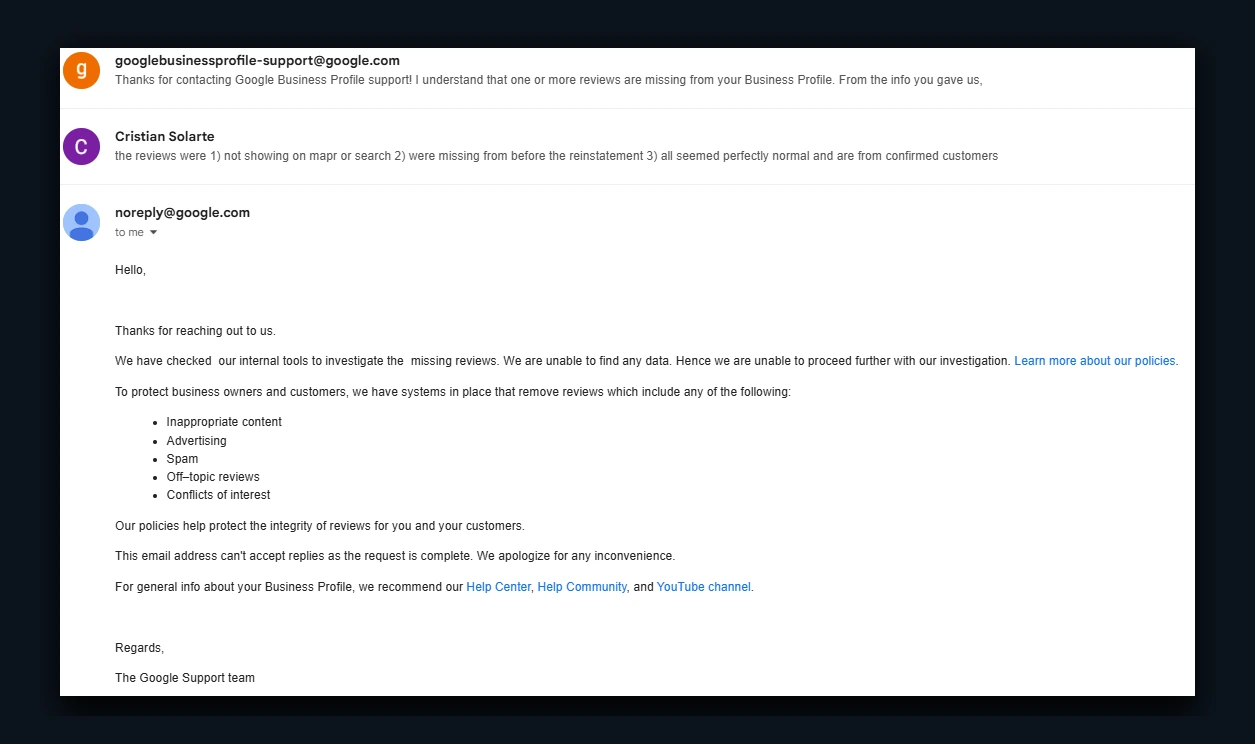
"We are unable to find any data." That's the answer, after the evidence. And with a company that size there's nobody above that to talk to — there's no review department with a phone number, no rep whose job it is to look at your screenshots. The thread just ends.
I'm not writing that to complain about Google. I'm writing it because a lot of agencies will tell you they can get your reviews back, and you should know what that process actually looks like before you pay someone for it.
So the useful takeaway isn't that support is unhelpful — it's that you can't count on recovering a review once it's gone. Which means the answer isn't appeals, it's volume. A business generating reviews consistently absorbs the filtering without ever really noticing. A business sitting at twenty feels every single one.
Where you rank isn't one number
One last thing that surprises most owners. You don't have a ranking on Google Maps — you have a different ranking at every point on the map. You can sit at number one from your own driveway and fall off the results entirely four miles up the road, which is exactly where a good chunk of your service area lives.
Grid-based rank tracking makes that visible. Instead of checking one position, it checks dozens of coordinates spread across your service area and colors each one by where you land. The result looks like this:
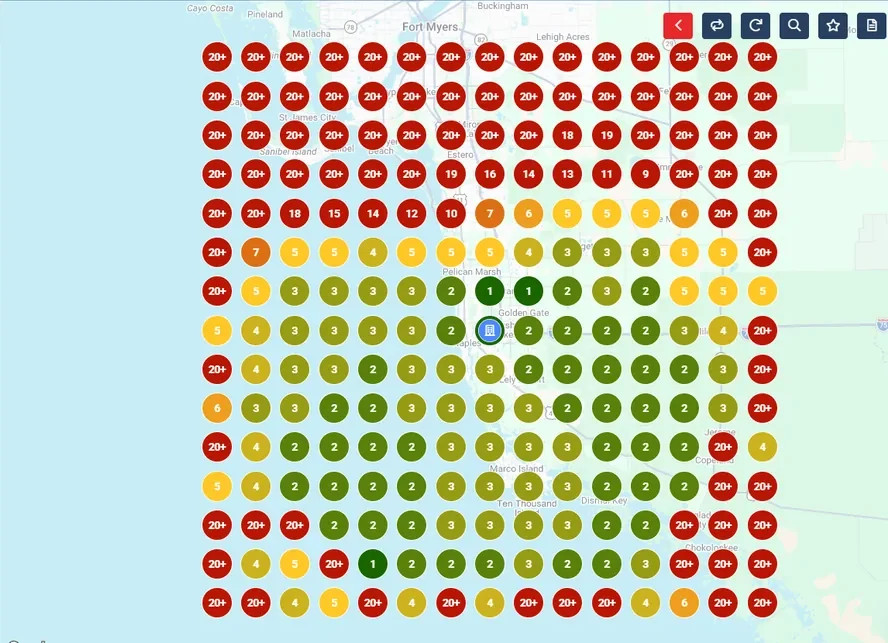
That picture usually reframes the whole conversation. "We rank fine" becomes "we rank fine in the two miles where we already get referrals, and we're invisible across most of the area we actually drive to." It also makes the honest version of the pitch easy: nobody is going to make you green everywhere, but you can watch that island grow.
Questions I get asked about this
Why does Google single out garage door and locksmith companies?
Both categories were overrun by listings that did not belong to real local businesses. Lead generation operations built networks of profiles across many cities, each looking local but routing calls to a central system that sold them on to contractors — pushing genuine local companies off the map in their own markets. On top of that, emergency calls from stranded customers were a reliable target for quote-one-price-charge-another operators. Advanced Verification is Google's response, and in the US it applies to locksmiths and garage door repair services.
Can I choose video verification instead of waiting for a postcard?
No. Google selects the method and it varies more than you would expect — I have had one profile verify from a phone number and a text message with no site visit at all, while others in the same period required a full on-location video. There is no known way to influence which one you get. Prepare for video and treat anything easier as a bonus.
Can I record the verification video on my phone and upload it?
No, and this catches almost everyone. The recording happens live inside Google's own interface on your phone — there is no upload option. That means you have to be physically at the location with everything staged before you start, and you get it right in one continuous take or you start again.
How long does Google Business Profile verification take for a garage door company?
Anywhere from instant to roughly two weeks. Automated review handles straightforward submissions quickly; anything unclear or appealed goes to human review, which is where most of the delay comes from. Plan for five to fourteen days.
Can I run Google Ads before my profile is verified?
Ads built before verification in these categories are automatically disapproved and will not serve. Get the website live, complete verification, then launch ads — running them in the other order means paying for campaigns that cannot show.
My profile was suspended. Is it recoverable?
Yes, but be ready for it to be a real process rather than a form. I have been through this twice, and both times it ended in a scheduled call with an actual Google representative, then a video call where we showed the business was real — the owner present, business documentation gathered and on hand, the location on camera. Before you get there, fix whatever caused it: usually a changed address, or details that no longer match between your listing, your website and your licensing paperwork. Get all of it identical, stop editing while the request is open, and expect to spend time on the phone. It is a pain, but it is doable.
Does a verified profile mean I will show up in the map pack?
No. Verification makes you eligible to appear. Where you actually rank depends on proximity to the searcher, category relevance, and prominence signals like review volume and consistency. In competitive trades, review volume is usually the deciding gap.
Want this working on your business?
I work with a small number of businesses at a time. If something here sounds like your situation, let's talk.
Let's Talk