
Traumoto
Motorcycle trauma kits and safety gear, shipping to 55 countries. Product-led structure with full purchase-event tracking.
Most sites are a brochure with a contact form stuck on the end. I build them as systems — every page doing a job, every path going somewhere, every action measured.
The Method
Making something look good is the easy part. Whether it actually earns you money gets decided earlier — in how it's structured, what each page is for, and whether you can see what's happening.
Nobody reads a website front to back. They land wherever your ad or a search result drops them, then wander sideways. So the homepage isn't the front door — it's just the busiest intersection. I map every page's role and its next step before any design happens, so there's no route that quietly dead-ends.
Every route lands in the same place. Nothing dead-ends.
A page trying to do four jobs does none of them well. Before I lay anything out, each page gets one question it exists to answer and one action it exists to prompt. If a section serves neither, it comes out. That's usually why these pages end up shorter — and work better.
Four zones, four jobs. Anything fitting none of them gets cut.
Tracking goes in while I'm building, not bolted on six months later. Every action that matters fires a named event into Analytics and the ad platforms, so you can see exactly where people are dropping off instead of guessing. Without it, every decision after launch is a coin flip with your budget on it.
Illustrative rates — yours get measured, not assumed.
Every site gets this method, and the price is published.
See prices and get started →Selected Work
Motorcycle trauma gear shipping to 55 countries. Performance parts at catalog scale. Different industries — same structural discipline underneath.
Motorcycle trauma kits and safety gear, shipping to 55 countries. Product-led structure with full purchase-event tracking.
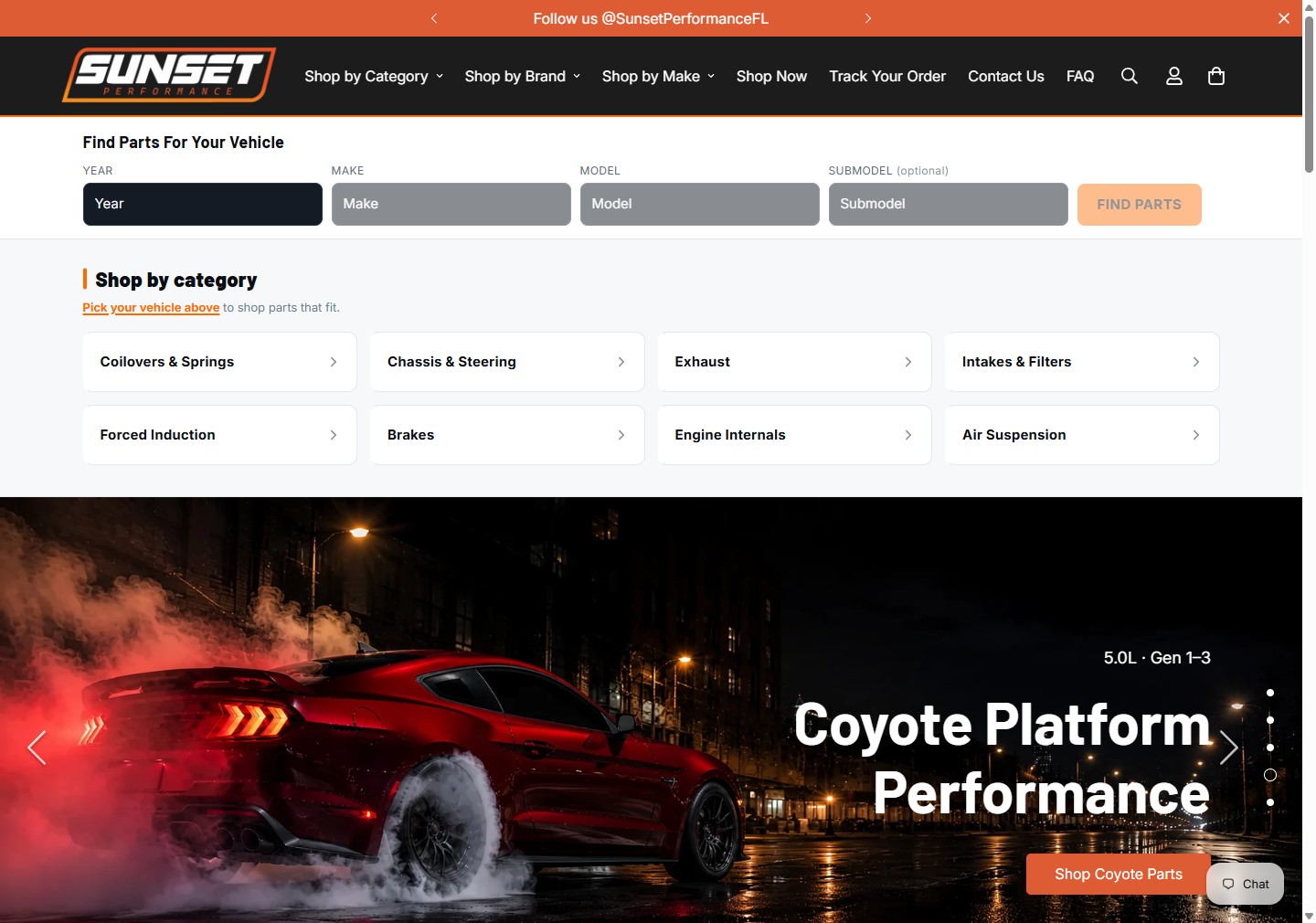
Performance auto parts at catalog scale — inventory, pricing and availability kept in sync with the distributor automatically.
Built Mobile-First
Most searches now happen on a phone — and for local service businesses it runs higher still. So mobile isn't the version I shrink down at the end. It's the one I design first, then expand.
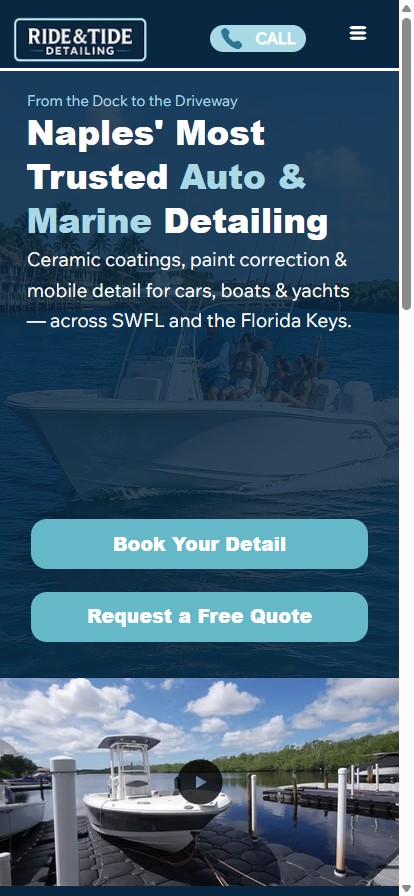

Want a site like these? Starter builds go live in about a week.
Get your website started →What matters in a site
A website is only the first part of the system. From the start, sites are built to work with tracking and analytics — whether that's Google Analytics, Search Console, or paid platforms like Google and Meta — so performance can be measured, optimized, and acted on.
Without clean tracking, decisions downstream are guesswork. This foundation ensures everything that follows is driven by real data.
A large share of search traffic now happens on mobile. It's more important than ever to have a site that performs well on all platforms.
We meticulously review and make any and all adjustments necessary to ensure quality across every device.
Every website we build goes through a rigorous SEO checklist to ensure you have the best chance of being found organically by your customers.
For those who want even more, we also offer Google search ads for sponsored placement at the top of the search results.
Any one of these on its own is a nice-to-have. Together they're the difference between a site that looks fine and a site that pays for itself.
FAQ
There are three ways to have one, all on the websites page. Starter, sold as Website in a week, is $1,500 to own, or $750 to start and then $100 a month for 12 months — $1,950 in the first year, hosting included — and it's yours: every page your business needs (a page for each service and each area you serve), written for you, schema and llms.txt, a mobile-first build, a lead vault on your own site, a text alert the moment a lead comes in, and your domain bought in your name. You pay $750 to start and the rest only when you love it. Business starts at $2,500 — 2D animated, illustrated motion that makes the site feel made for your business, plus a bigger owner dashboard (lead stages, notes, ad attribution) and one working tool, like a photo upload or a quote tool. Premium starts at $5,000 — fully animated and cinematic, with the bigger dashboard too. Business and Premium are half to start and half on approval. If you own the site, hosting and care is optional: $50 a month only if I host it, and nothing while you are on a retainer with me. I will tell you which one you actually need before quoting, and I will tell you if it is the cheapest one.
About a week for Website in a week, counted from the business day after your deposit has cleared and your questionnaire is done. Your logo and photos are not needed to start: I pull them from your website and socials, and you can send better ones if you have them. Business and Premium are animated from scratch, so each one is quoted with its own timeline. Either way, the bottleneck is almost always getting content back, not the build itself.
Two written revision lists. You send one clear list of changes through the form, I make every change and send it back, normally within three business days, and then you can send a second. That is usually enough to get it exactly how you want it — and because it is written down, nothing said in passing gets lost.
If you buy it outright — Starter at $1,500, Business or Premium — it is yours once it is paid in full, and I host it for $50 a month if you want me to. On the Plan — $750 to start, then $100 a month for 12 months, $1,950 in the first year, hosting included — I host it and look after it while you pay, with a 3-month minimum: the first three payments are not optional. After the first three months you can leave any time for the lesser of $500 or the payments you have left, and you keep the files and host them wherever you like. After the 12th payment it is yours, and from then on hosting is $50 a month if you keep it with me (nothing while you are on a retainer with me), or you take the files with 30 days' notice. Either way, your domain, your content, your leads and your accounts are always yours.
They are fine for looking present. They are weaker at the parts that decide whether the site earns anything — page speed, structured data, tracking wired in at build time, and control over how the whole thing is put together. I moved my own site off Wix for exactly those reasons.
It is built mobile-first, because around 80% of your traffic will be on a phone. That means the phone layout is the one designed first and the desktop version adapts to it, rather than the other way round.
If your site looks fine but nothing's happening, it's usually structural. Structural is fixable.