The most common thing I hear from business owners about Facebook ads is some version of: "we tried it, we picked our audience, it didn't work." That sentence made sense in 2019. It doesn't describe how the platform works anymore, and the gap between those two things is where a lot of money gets wasted.
Across 2024 and 2025 Meta rebuilt the machinery that decides which ad lands in front of which person. It wasn't a settings change and there was no banner in your Ads Manager. It changed the order of operations underneath everything.
Here's the shift in one line: your creative is now the targeting. The audience boxes you fill in are context, not command.
It isn't one algorithm. It's three models in a row.
Most write-ups on this — including, until recently, my own explanation of it — talk about "Andromeda" as though it's the whole system. It isn't. It's one of three, and knowing which one does what is the difference between guessing and diagnosing.
- 1
Andromeda — retrieval
At any moment there are tens of millions of ads that could be shown to a given person. Andromeda's job is to cut that down to a shortlist of a few thousand, fast. Critically, it does this by reading your ad — the visuals, the video, the words on screen, the spoken transcript, the format. This is the layer that made creative into a targeting signal.
- 2
Lattice — ranking
The shortlist then gets ranked. Lattice predicts how each ad will actually perform — engagement, quality, likelihood of the conversion you asked for — and orders them. It replaced a pile of separate specialized models with one that learns across every campaign objective at once, so a lesson learned on one objective improves the others.
- 3
GEM — the teacher
The third one never touches your campaign directly. GEM is a foundation model trained at roughly the scale of a large language model, across everything Meta sees — ads and organic, all surfaces. It's far too expensive to run on live traffic, so instead it teaches: what it learns gets distilled down into Andromeda and Lattice. The "generative" part throws people; it doesn't generate your creative, it generates predictions.
Then the auction runs on what's left — your bid, the predicted action rate, and the quality of the ad — and one ad gets shown.
The practical consequence of the teacher model is that this system improves on its own, continuously, without anyone touching your account. The playbook that worked last quarter isn't degrading because you got worse. It's degrading because the thing you're advertising into keeps getting better at its job.
What actually changed
The old model was a filter. You told Meta who to show the ad to, Meta showed it to roughly those people, and the creative was just the thing that appeared at the end of that pipe. Better targeting was the lever.
The new one runs it backwards. Before anything decides who's eligible to see your ad, the system reads the ad itself — the hook, the visual structure, the format, the theme, the language, and how similar things have performed. It builds an understanding of what this ad is, then goes and finds the people most likely to respond to that. If your interest settings disagree with what the creative signals, the creative usually wins.
You're no longer aiming the ad at an audience. You're publishing a signal, and the system decides who it's for. Change the creative and you have changed the targeting, whether or not you touched a single setting.
What this means for a local business, practically
Four things follow from that, and they're the ones I end up explaining most often.
- 1
Interest stacking is a dead lever
Layering ten or fifteen specific interests to build the "perfect" audience was already losing power when Meta made detailed targeting advisory rather than directive. Under Andromeda it's mostly theater. Broad targeting with strong creative now beats a narrow, hand-built audience with weak creative in most accounts I've looked at.
- 2
Geography is still a hard control — use it
Not everything went soft. Your service radius, language, minimum age and your exclusion lists are still respected as constraints. If you're a home service business, set the geography as a hard boundary every single time. That's the one place manual control still does real work.
- 3
Your creative budget is now part of your media budget
If creative is the targeting mechanism, then producing creative isn't a nice-to-have you do when there's time left over — it's the actual input the system optimizes against. Under-investing in creative is now the same thing as under-investing in targeting.
- 4
Fewer, bigger, simpler
Fragmenting a small budget across six campaigns and twenty ad sets starves every one of them of the data it needs to learn. One campaign per objective, a handful of ad sets, broad targeting, and let the system do the sorting it's now built to do.
If that sounds like an opinion, it isn't. Meta says it out loud in its own interface. Try to narrow an audience and it will stop you on the way past:
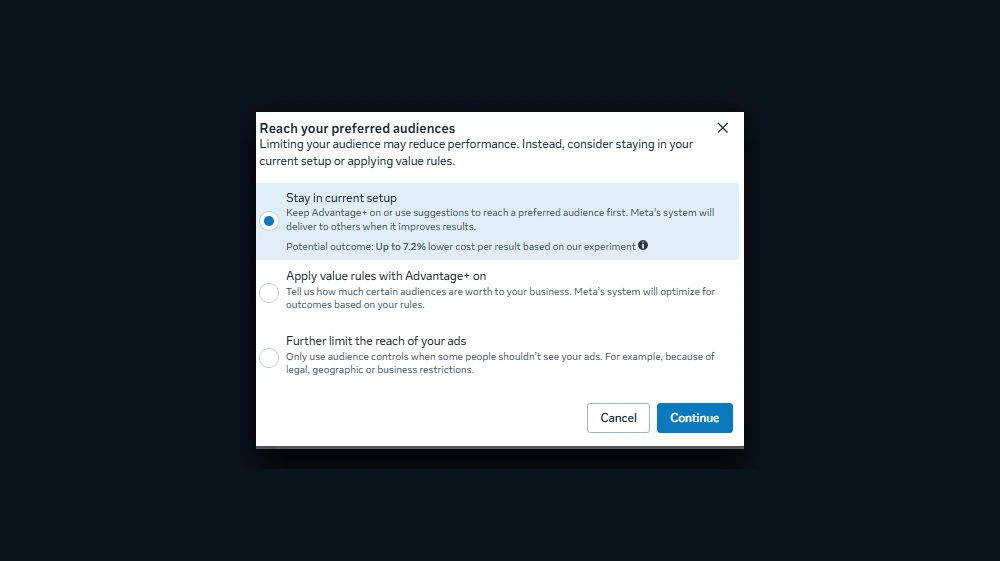
That's the whole shift in one dialog. Narrowing is described as a cost, staying broad is the recommendation, and manual audience control has been demoted to a compliance tool. Whether you agree with Meta or not, that's the system you're advertising inside.
Creative burns out faster than it used to
This is the practical cost of the new model, and it catches people off guard. When creative is the signal the system optimizes on, the system exhausts that signal quicker. Ads that used to run for months now fade in weeks.
So the job changes shape. It stops being "make a great ad and run it" and becomes "run a small production line." You need new variants entering the account on a schedule, not when someone notices performance sagging — by then you've already paid for the decline.
What good creative looks like when the machine is reading it
Video generally outperforms static, and the first two to three seconds decide almost everything — that's where the system and the human are both forming their read. Fifteen to thirty seconds is the working range for Feed and Reels, and Reels needs true vertical, not a square with bars.
The formats that hold up for local service businesses aren't expensive:
- Before and after. The single highest-performing static for home and auto work, and it costs nothing but the discipline to photograph every job from the same angle twice.
- A real customer on a phone camera. Beats a polished studio testimonial more often than not. Production value reads as advertising; a slightly shaky real person reads as evidence.
- The work itself. Time-lapse, walkthrough, the thing being done properly. People want to see competence before they call a stranger to their house.
On the copy side, the rules haven't changed as much as the mechanics have. Address the objection instead of listing the feature. Be specific rather than enthusiastic — a real number about work you've actually done beats any adjective. And match the ask to the intent: a "free quote" button that opens a twelve-question form is where most of your conversions quietly die.
So is it worth running Meta ads at all?
Yes, but with an honest framing. Meta is demand generation — you're interrupting someone who wasn't looking for you. That's a different job from Google, where you're capturing someone who's already searching. Meta rewards businesses that can show the work convincingly, and it punishes businesses that treat creative as an afterthought harder than it used to.
If you have real jobs you can photograph and real customers who'd say something nice on camera, you have the raw material the current system is built to reward. If you don't, no amount of audience configuration is going to save the campaign — and that's the part that's genuinely new.
Questions I get asked about this
What is Meta Andromeda?
Andromeda is the retrieval layer of Meta's ad system, introduced at the end of 2024. Its job is to narrow tens of millions of eligible ads down to a shortlist of a few thousand for a given person, and it does that by evaluating the ad creative itself — visuals, video, on-screen text and format — rather than starting from the advertiser's audience settings. It is one of three models, not the whole system.
What are Andromeda, Lattice and GEM?
They are the three models behind Meta ad delivery. Andromeda handles retrieval — narrowing tens of millions of ads to a shortlist by reading the creative. Lattice handles ranking — predicting engagement, quality and conversion across every objective at once, and ordering the shortlist. GEM is a foundation model trained at language-model scale that never serves ads directly; it learns across Meta's whole ecosystem and distills what it learns into the other two. After those three, a standard auction on bid, predicted action rate and ad quality picks the single ad shown.
Why do my Meta campaigns keep getting worse over time?
Often because the system is improving rather than your account degrading. The teacher model continuously pushes what it learns into the retrieval and ranking layers, so the competitive bar rises without anyone touching your campaigns. A static creative library loses ground against that by default, which is why refresh cadence matters more now than campaign structure tinkering.
Does interest targeting still work on Facebook ads?
Interests still exist but they function as context rather than a hard filter. Meta can and does deliver outside your specified interests when creative signals point somewhere better. Broad targeting paired with strong creative now outperforms narrow interest stacking in most accounts.
What targeting settings does Meta still respect strictly?
Geographic service area, language, minimum age and custom audience exclusions are still treated as hard constraints. For local service businesses, always set the service radius as a hard boundary rather than leaving it broad.
How often should I refresh my ad creative?
Faster than you used to. Under the current system creative fatigues in weeks rather than months, so plan on introducing new variants every few weeks as a standing process rather than reacting once performance drops.
Should I turn on Meta's Advantage+ creative enhancements?
Leave placement optimization on, because correct cropping for Feed, Stories and Reels genuinely helps delivery. Turn off the cosmetic enhancements — brightness changes, text overlays, background swaps and auto-animation — because they alter your brand presentation without approval. They default to on, so you have to opt out manually at the ad level.
Want this working on your business?
I work with a small number of businesses at a time. If something here sounds like your situation, let's talk.
Let's Talk